
.png)
🧠 How async/await Works in JavaScript (Even Though It’s Single‑Threaded)
JavaScript is single-threaded, yet it handles asynchronous operations effortlessly using async/await, the event loop, and promises. Learn how async code works behind the scenes and why it doesnt block the execution of your applications.
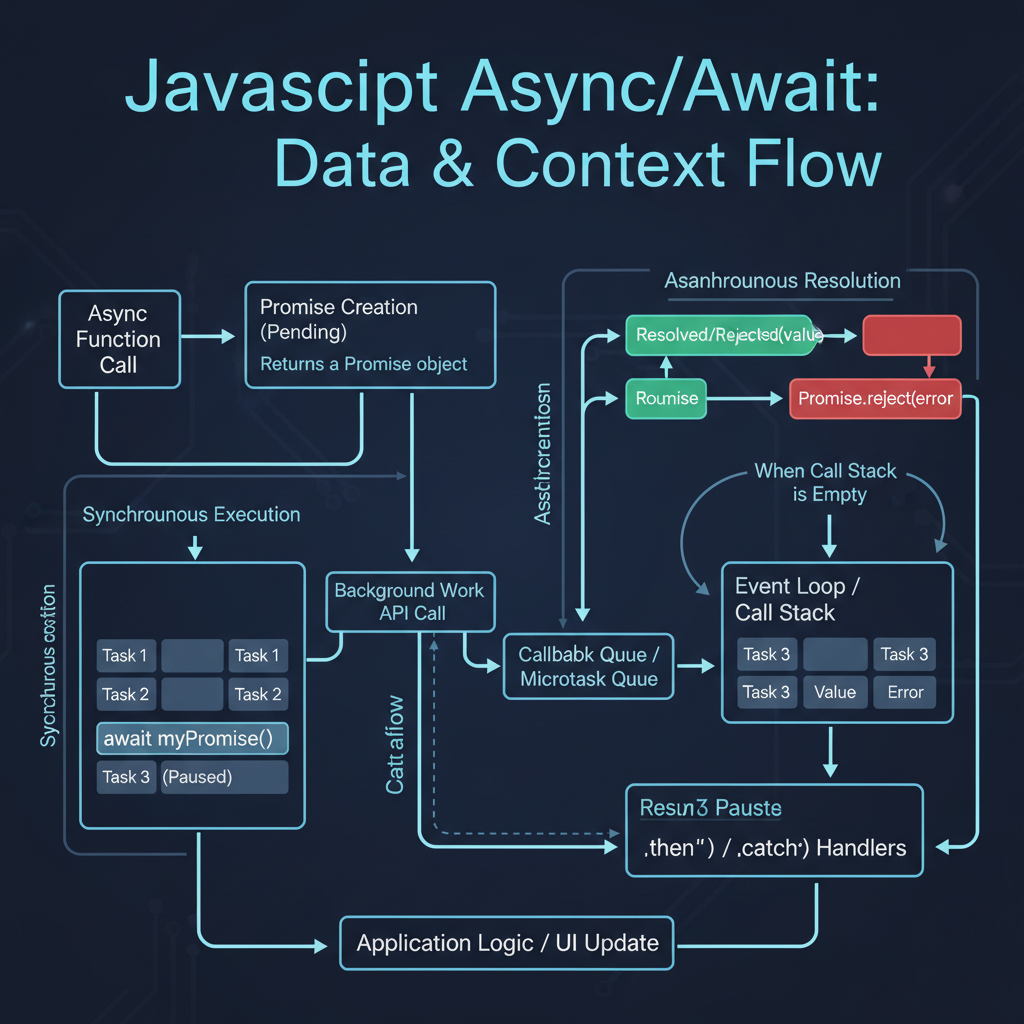
JavaScript often confuses developers with its ability to handle asynchronous operations smoothly—even though it is fundamentally single-threaded. Let’s break this down with a simple, intuitive explanation and connect it to how async/await works under the hood.
⚙️ JavaScript is Single-Threaded… So How Does It Do Async?
JavaScript has one call stack, meaning it executes code one task at a time.
JavaScript
console.log("Start");
console.log("End");
Output:
Start
End
Straightforward, right? But things get interesting when asynchronous operations come into play.
🔄 The Secret: Event Loop + Web APIs
JavaScript uses a clever system made up of:
- ✅ Call Stack – where code executes
- ✅ Web APIs (Browser/Node) – handle async work (timers, fetch, etc.)
- ✅ Callback / Microtask Queue
- ✅ Event Loop – coordinates everything
Example:
console.log("Start");

setTimeout(() => {
    console.log("Timeout done");
}, 2000);

console.log("End");
Output:
Start
End
Timeout done
👉 Even though setTimeout is called first, the callback runs later because it's handled outside the main thread.
⏳ Enter Promises
async/await is built on top of Promises.
const promise = new Promise((resolve, reject) => {
    setTimeout(() => resolve("Done!"), 1000);
});

promise.then(console.log);
Promises represent future values.
✨ What Does async/await Do?
async/await is syntactic sugar that makes asynchronous code look synchronous.
Example:
JavaScript
async function fetchData() {
    console.log("Fetching...");

    const result = await new Promise((resolve) =>
        setTimeout(() => resolve("Data received"), 2000)
    );

    console.log(result);
}

fetchData();
console.log("After fetch call");
Output:
Fetching...After fetch callData received
🔍 How await Works Internally
When JavaScript encounters:
JavaScript
await somePromise;
Here’s what happens step-by-step:
- Function execution pauses at
await - The promise is handed off to the event loop
- The main thread is freed to run other code
- Once the promise resolves:
- The function resumes from where it stopped
👉 Important: The thread is NOT blocked — only the function context is paused.
🚦 Key Insight: It’s Cooperative, Not Parallel
JavaScript doesn’t run multiple threads (by default), but it:
- Delegates async tasks to Web APIs
- Uses queues to schedule callbacks
- Resumes execution via the event loop
So:
✅ Concurrency without multithreading
🧩 Microtasks vs Macrotasks
- Microtasks (higher priority):
- Promises (
then,await)
- Promises (
- Macrotasks:
setTimeout,setInterval
Example:
JavaScript
console.log("Start");

setTimeout(() => console.log("Timeout"), 0);

Promise.resolve().then(() => console.log("Promise"));

console.log("End");
Output:
StartEndPromiseTimeout
🧠 Mental Model
Think of it like:
🍽 A chef (JavaScript thread)
🧾 Orders (tasks)
👩🍳 Assistants (Web APIs)
The chef doesn’t wait for one dish to cook—he delegates, keeps working, and comes back when it's ready.
✅ Why async/await Feels Synchronous
Because:
- Code is written top-down
- Error handling uses
try/catch - No nested callbacks
JavaScript
async function example() {
try {
const data = await fetch("https://api.example.com");
console.log(await data.json());
} catch (err) {
console.error(err);
}
}
Show more lines
🚀 Final Takeaways
- JavaScript is single-threaded ✅
- Async behavior is powered by:
- Event Loop
- Web APIs
- Task queues
async/await:- Doesn’t block the thread ❌
- Pauses execution of just that function ✅
- Makes async code cleaner, readable, and maintainable ✨